
BATTERY — How to Handle Battery (Cont'd) — Sulphation / Specific Gravity Check
EL-17prose procedureSulphation kicks in below SG 1.100 — irreversible once it has formed for any length of time. The SG-vs-temperature chart is essential because uncorrected readings can be off by 0.030 between -10°C and +35°C.
How to Handle Battery (Cont'd)
SULPHATION
NOTE
When a battery has been left unattended for a long period of time and has a specific gravity of less than 1.100, it will be completely discharged, resulting in sulphation on the cell plates.
Compared with a battery discharged under normal conditions, the current flow in a "sulphated" battery is not as smooth although its voltage is high during the initial stage of charging, as shown in the figure at the left.
SPECIFIC GRAVITY CHECK
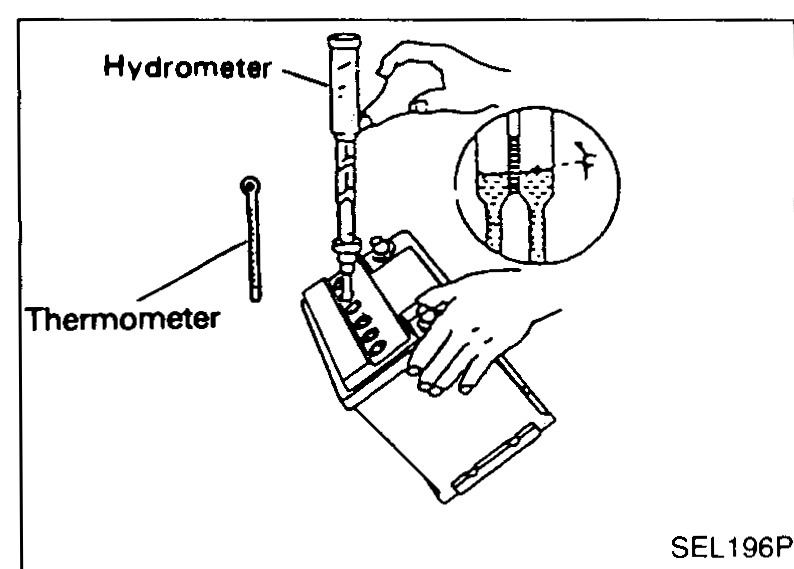
- 1Read hydrometer and thermometer indications at eye level.
- When electrolyte level is too low, tilt battery case to raise it for easy measurement.
 UEL022
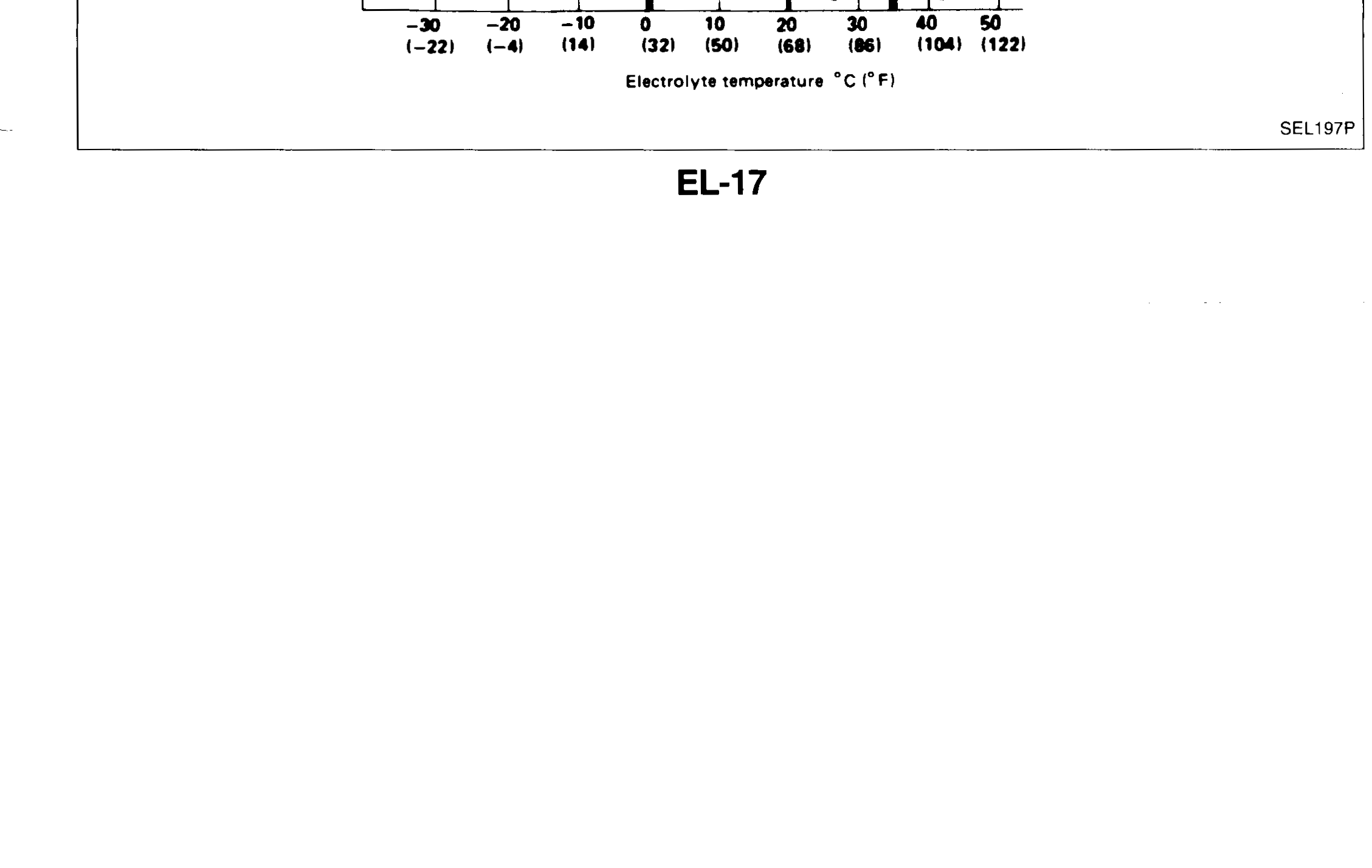
 - 2Convert into specific gravity at 20°C (68°F).
- Example: When electrolyte temperature is 35°C (95°F) and specific gravity of electrolyte is 1.230, converted specific gravity at 20°C (68°F) is 1.240.
- Example: When electrolyte temperature is 0°C (32°F) and specific gravity of electrolyte is 1.210, converted specific gravity at 20°C (68°F) is 1.196.
 SEL197P
| Specification | Value |
|---|---|
| Sulphation threshold (specific gravity below which sulphation occurs) | 1.100(specific gravity) |
| Conversion example 1 — 1.230 @ 35°C | 1.240converted to 20°C |
| Conversion example 2 — 1.210 @ 0°C | 1.196converted to 20°C |
Sulphation threshold (specific gravity below which sulphation occurs)
1.100(specific gravity)
Conversion example 1 — 1.230 @ 35°C
1.240converted to 20°C
Conversion example 2 — 1.210 @ 0°C
1.196converted to 20°C