
ENGINE REMOVAL — Warnings and Removal Steps (Supplement-V)
EM-5032prose procedureWARNING
Situate vehicle on a flat and solid surface.
Place chocks at front and back of rear wheels.
Do not remove engine until exhaust system has completely cooled down.
For safety during subsequent steps, the tension of wires should be slackened against the engine.
Before removing front axle from transaxle, place safety stands under designated front supporting points. Refer to GI section for lifting points and towing.
Be sure to hoist engine and transaxle in a safe manner.
For engines not equipped with engine slingers, attach proper slingers and bolts described in PARTS CATALOG or Eurofast.
CAUTION
When lifting engine, be careful not to strike adjacent parts, especially accelerator wire casing, brake lines, and brake master cylinder.
Always use engine slingers when hoisting the engine.
When removing drive shaft, be careful not to damage transaxle oil seal.
Removal
Engine removal
- 1Remove engine undercovers and splash guards.
- 2Remove front exhaust tube.
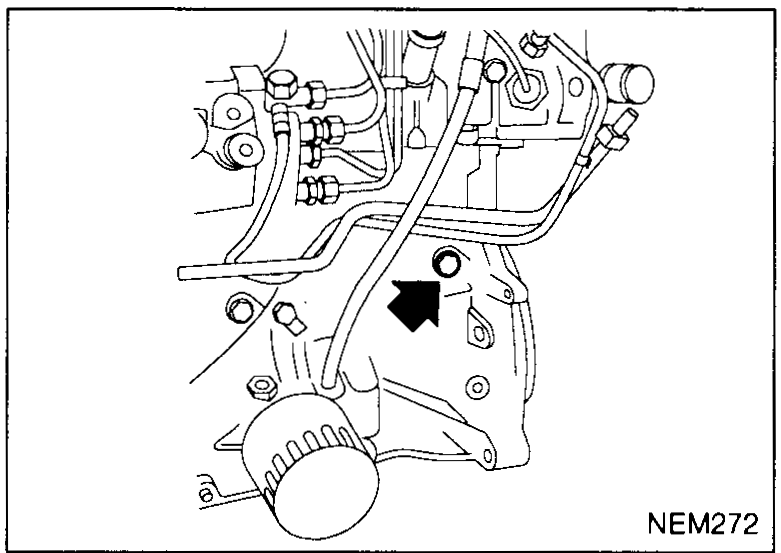 NEM272
 - 3Drain coolant from both radiator and engine.
- 4Drain transaxle oil.
- 5Remove hood.
- 6Remove fresh air duct.
- 7Disconnect all coolant hoses from engine.
- 8Disconnect fuel tubes and vacuum tubes.
- 9Release drive belt adjusting bolts and remove power steering pump from engine. Bind pump properly to the vehicle.
- 10Remove the battery and the battery tray.
- 11Disconnect or remove electrical wiring where necessary.
- 12Disconnect clutch lever cable and accelerator cable.
- 13Disconnect speedometer and neutral switch connector from transaxle housing.
- 14Remove front wheels.
- 15Remove brake caliper mounting bolts and bind caliper properly to vehicle LH & RH.
- 16Disconnect tie rod ball joints and lower ball joints (LH & RH).
- 17Remove stabilizer.
- 18Remove drive shafts from transaxle.
- 19Mount suitable slingers to cylinder head. Use a suitable hoist to release the force on the engine mountings.