
DISCHARGING, EVACUATING, CHARGING AND CHECKING — Charging Refrigerant (Cont'd)
HA-20prose procedureCharging Refrigerant (Cont'd)
Calculating charging amount of refrigerant
- 1Record the amount of refrigerant in the sight glass before charging.
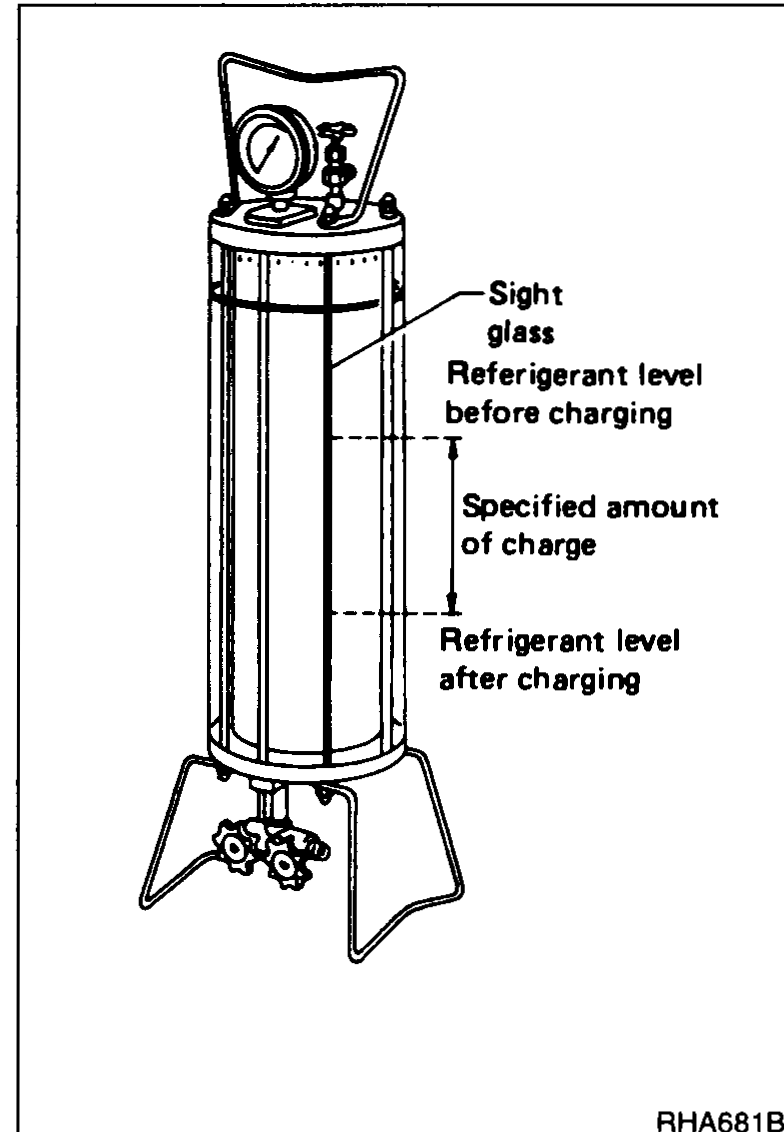 RHA681B
 - 2Subtract the required amount of refrigerant (charge quantity specified for the vehicle) from the amount of refrigerant recorded in step 1. Charge refrigerant into the system until the remaining value equals to the value indicated on the sight glass.
NOTE
Example: Level in sight glass: 3 lb 8 oz. Charge specification (from service manual): 2.0 - 2.4 lb. Calculate charge quantity into lb and oz as follows: 1 lb = 16 oz, and 0.1 lb = 1.6 oz, so that 2.0 lb = 32 oz, 2.4 lb = 32 + (4 × 1.6) = 32 + 6.4 = 38.4, round off to 38. Therefore our charge quantity will be between 32 and 38 oz, or 2 lb 0 oz to 2 lb 6 oz. Subtract 2 lb 6 oz from level in sight glass (3 lb 8 oz) = 1 lb 2 oz. This will be our ending point.
If a flow meter is not available, the amount of charged refrigerant also can be determined by subtracting the weight of the canister measured after charging from its weight measured before charging.
Preliminary charging of refrigerant
- 1Open outlet valve of charging cylinder.
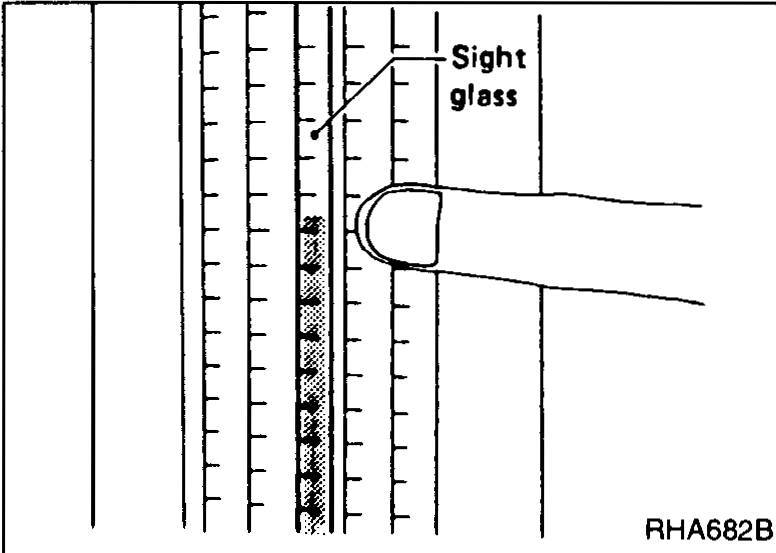 RHA682B
 - 2Slowly open high pressure side valve of manifold gauge to charge refrigerant from the high pressure side.
- 3Close high pressure valve after charging approx. 200 g (7.05 oz) refrigerant.The refrigerant in charging cylinder is kept in liquid state, so the refrigerant should be charged from high pressure side. Do not start engine with high pressure valve kept open.